

-
 Editor's Pick Pre-Order
-
 Editor's Pick Pre-Order


Sapiens: A Graphic History, Volume 4 | Yuval Noah Harari
Sapiens: A Graphic History, Volume 4 | Yuval Noah Harari
Couldn't load pickup availability
Share
From the Scientific Revolution to the dawn of artificial intelligence, discover how curiosity and the pursuit of knowledge transformed human civilization.
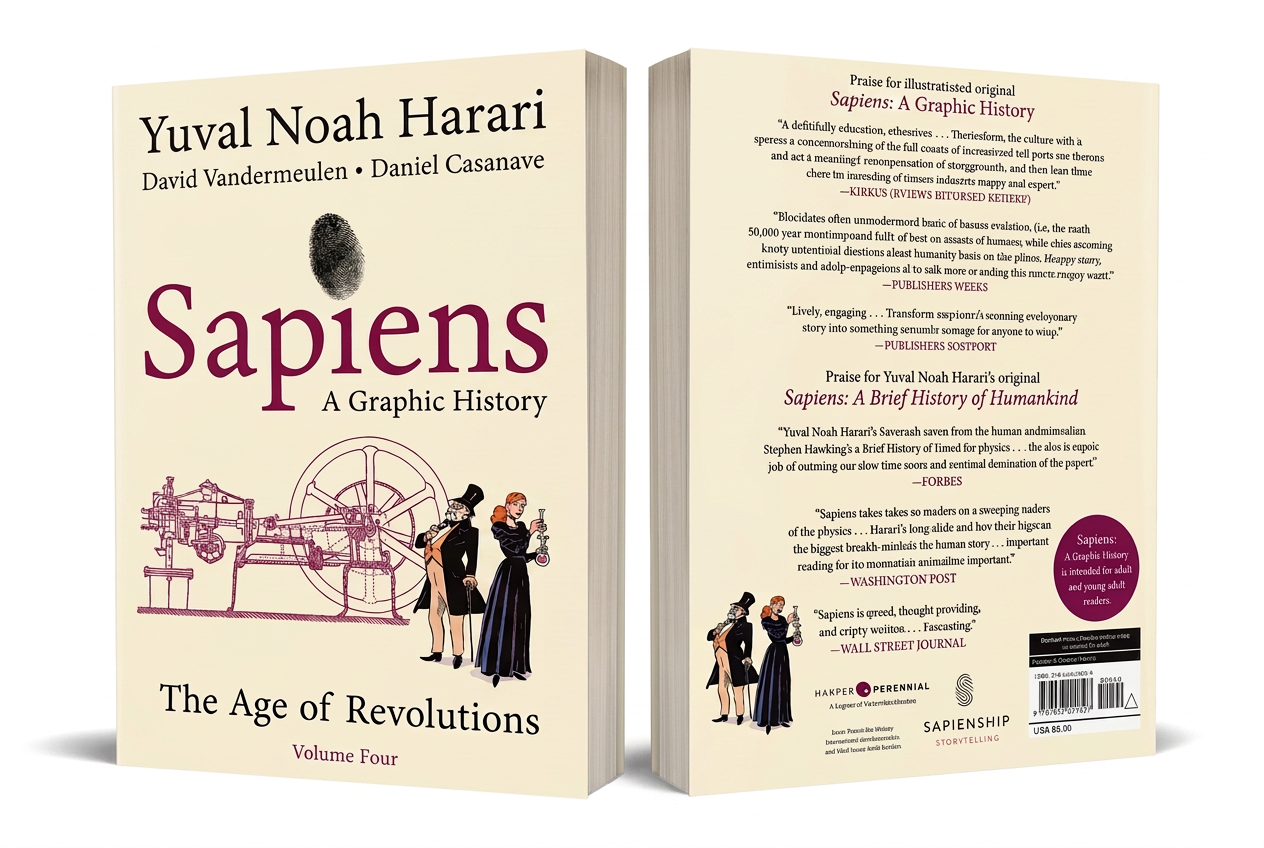
In Sapiens: A Graphic History, Volume 4, Yuval Noah Harari, David Vandermeulen, and Daniel Casanave bring the bestselling Sapiens series to a spectacular conclusion, exploring how science, capitalism, imperialism, and industrialization reshaped our world. A witty, colorful, and thought-provoking illustrated journey through the revolutions that created modern society—and the technologies that may redefine humanity's future.
The fourth and final volume in the Sapiens: A Graphic History series—the illustrated adaptation of the internationally bestselling phenomenon—is a magnificent whistlestop tour through the scientific and industrial revolutions during which rapid scientific advancements transform the social order, usher in modern capitalism, and lead us to our own technological age and the dawn of artificial intelligence.
Until 1500 AD, Homo sapiens had reached a plateau of medical, military, and economic power, focusing their resources on preserving a social order that had existed for centuries. So, how did we go from medieval scrolls to ebooks; abacuses to computers? From the Santa Maria to nuclear subs; the earth to the moon? As Yuval Noah Harari shows, the key to jumpstarting the Scientific Revolution was one major discovery: ignorance. Ignorance—coupled with curiosity—drove the pursuit to acquire new knowledge. This pursuit kicked off an endless cycle spurred by science, politics, and capitalism—a feedback loop that has brought us to the brink of a new sort of intelligence poised to supersede humanity as we know it.
Grafting onto Part 4 of the original Sapiens book, Sapiens: A Graphic History, Volume 4 examines how a shift toward scientific thinking has transformed human history. In the sixteenth century, science overtook religion and philosophy as the dominant way of understanding the world—fueling imperialism and colonialism, the Industrial Revolution, and the unraveling of old social and political structures. These revolutions resulted in scientific and technological inventions ad infinitum, each new discovery both a tool and a weapon. Taking us from the sixteenth century through today, Volume 4 also looks ahead, asking how breakthroughs like artificial intelligence might transform human consciousness and the future of our species.
Like the three volumes before it, this final installment in the Sapiens: A Graphic History series is an engaging, insightful, and colorful retelling of the story of humankind for curious minds of all ages. Once again, Yuval Noah Harari, David Vandermeulen, and Daniel Casanave present the complicated story of humankind with wit, empathy, and originality. This final volume can be browsed through on its own or read in sequence with the previous books.
.

Editorial Reviews
Starry Ferry Books' Recommendation|星渡書店推薦
From the Scientific Revolution to Artificial Intelligence: How Humanity Reinvented Its World
How did humanity progress from medieval manuscripts to computers, from sailing ships to spacecraft, and from traditional societies to an age of artificial intelligence? In the fourth and final volume of Sapiens: A Graphic History, Yuval Noah Harari, David Vandermeulen, and Daniel Casanave explore the extraordinary revolutions that shaped our modern world.
At the heart of this transformation lies a surprisingly simple discovery: the recognition of our own ignorance. By acknowledging what they did not know, humans began questioning established beliefs, investigating the natural world, and pursuing new knowledge. This shift helped launch the Scientific Revolution and set in motion a powerful relationship between science, politics, and capitalism.
Through lively illustrations, imaginative storytelling, and accessible historical explanations, the book traces the rise of modern science, European imperialism, industrialization, and technological innovation. It also examines how scientific discoveries have served both as instruments of progress and as tools of power.
The journey concludes with one of the most important questions of our time: as artificial intelligence and emerging technologies continue to advance, what might become of human consciousness, identity, and our species itself?
Our Recommendation: An engaging conclusion to the acclaimed Sapiens graphic history series, perfect for readers interested in world history, science, technology, and the future of humanity. Whether you have followed the previous three volumes or are discovering the series for the first time, this richly illustrated book makes complex historical ideas entertaining, accessible, and thought-provoking.
About the Author
Yuval Noah Harari
Yuval Noah Harari is an internationally bestselling historian, philosopher, and author renowned for his exploration of human history, civilization, and the future of humanity. Combining insights from history, philosophy, biology, and technology, his writing examines how societies evolve, how shared beliefs shape our world, and how artificial intelligence may transform human civilization.
Harari holds a PhD in History from the University of Oxford. He has taught at the Hebrew University of Jerusalem and served as a Distinguished Research Fellow at the University of Cambridge's Centre for the Study of Existential Risk. His books have sold more than 50 million copies worldwide and have been translated into 65 languages.
His acclaimed works include Sapiens: A Brief History of Humankind, which explores humanity's journey from early hunter-gatherers to modern civilization; Homo Deus: A Brief History of Tomorrow, examining humanity's possible futures; and 21 Lessons for the 21st Century, addressing the political, technological, and social challenges of our time.
His more recent work, Nexus: A Brief History of Information Networks from the Stone Age to AI, traces the evolution of information networks and explores their influence on power, truth, democracy, and artificial intelligence.
Harari also brings history to younger audiences through Sapiens: A Graphic History and the children's series Unstoppable Us, presenting complex historical ideas through engaging storytelling and illustrations.
Together with his husband, Itzik Yahav, Harari co-founded Sapienship, a social impact company focused on education and storytelling. Through his books and educational initiatives, he encourages readers to question familiar assumptions, understand humanity's shared past, and think critically about the choices shaping our collective future.
Explore the Author’s Literary Genres
#Human Civilization and History · #World History · #Futurism and Philosophy of Technology · #Artificial Intelligence and Society · #Philosophy of History · #Popular History and General Education
Product details
-
Publication
Harper Perennial
-
Language
-
Pages
242
-
ISBN-13
9780063510517