


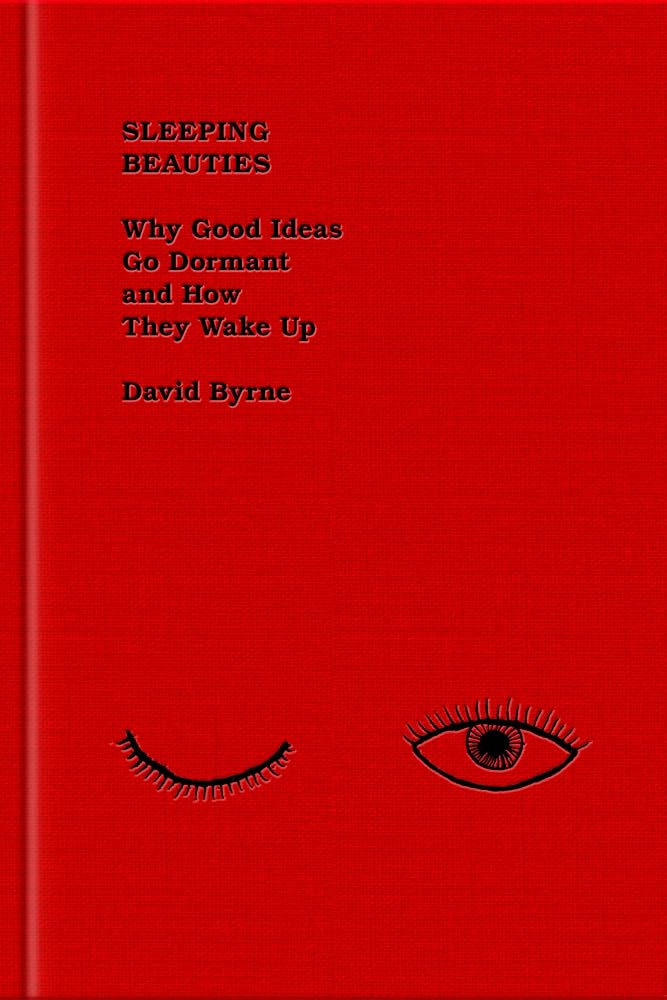
Sleeping Beauties: Why Good Ideas Go Dormant and How They Wake Up | David Byrne
Sleeping Beauties: Why Good Ideas Go Dormant and How They Wake Up | David Byrne
Couldn't load pickup availability
Share
From incomparable creative force David Byrne, a brilliant and inspiring reckoning with how breakthroughs across the arts and sciences get forgotten, and how they get rediscovered
It’s nice to believe in a meritocracy of ideas—genius is always recognized, innovation always seized upon and rewarded. In fact, so many of the people we now acknowledge as the world’s great creators initially got little traction for their work. It faded out, and only later—often much later—did it somehow came roaring back to life.
Discoveries as diverse as dark matter, lichen, and continental drift . . . technologies from solar panels to the steam engine . . . artists from Bach to Bruegel, Vermeer to Melville . . . all, David Byrne shows us, were sleeping beauties. Why did they fall asleep? How did they wake back up? Ranging across centuries and the full scope of human endeavor, Byrne arrives at important conclusions that serve as a lens for bringing to light new seeds for our future breakthroughs.
Sleeping Beauties is a master class in how not to be blind to the next great thing. Several times throughout history, the shock of the new landed like a blow on vested interests and entrenched views, putting innovation on hold. Suppression emerged from pushback, the absence of key supporters, or simply a lack of complementary economic conditions.
But more important even than why ideas go dormant is why they reawaken. Again and again, Byrne shows, someone from a different discipline breaks into the silo. Frequently it’s someone open to metaphorical thinking, to the counterintuitive. Hierarchies and taxonomies have their place, but they can reward insiders and punish outsiders. Oftentimes, it is the winds of change that blow away the sand that has buried momentous ideas.
Sleeping Beauties is humbling but it is also remarkably hopeful. These stories add up to a compass that leads us to the courage to try new things and the wisdom to embrace them. In a time that can seem all too dark, it’s a powerful source of freely available light, delightful in itself and fit for all our human endeavors.
.
Editorial Reviews
Professional Review
From Botticelli’s paintings to The Great Gatsby to handwashing, some of humanity’s most important achievements in culture, science, and technology were abandoned and then re-embraced years or sometimes centuries later, explains musician and artist Byrne (How Music Works) in this delightful survey of rediscovered art and ideas. The author begins by recalling his own “revelation” when first encountering and subsequently helping to revive Brazilian Tom Zé’s “radical boundary-pushing music.” Further inspired by a 2004 paper on overlooked scientific ideas that termed them “sleeping beauties,” Byrne surveys such re-emergent artworks and theories, highlighting what drove their revitalization, from passionate individual champions, like Salvador Dalí’s admiration for Gaudí’s architecture, to simple accidents, like Hugo de Vries and Carl Correns “separately and unwittingly” retreading Gregor Mendel’s work on genetics decades later. Along the way, Byrne imparts a contagious enthusiasm for everything from concrete to radio astronomy, bolstered by his quirky sense of humor (on Caravaggio: “Why was he such a crazy asshole?”). The book loses steam as Byrne slows down to list requirements for sleeping beauties (“useful and relevant”; “accessible”) and necessary conditions for their reawakening, like cross-disciplinary collaboration. Still, the cumulative effort wisely counsels against recency bias, as it reveals “how often our opinions and beliefs have changed.” It’s a wonderful and humbling celebration of the lost and found. —Publishers Weekly
Review
“Byrne guides us on a captivating quest to understand how we come to remember forgotten ideas, inventions and technologies. With striking dexterity and range, he explores how advocates reawakened Bach’s compositions and Vermeer’s paintings after one and two centuries of slumber; how technological advances rekindled theories of continental drift and black holes; how accidents resuscitated hand-washing and genetics; and how war renewed interest in the submarine and The Great Gatsby . . . He is acutely aware that there is no surefire formula for making ideas last or bringing them back to life. What he presents is far more valuable: a deeply researched, stimulating inspection of how the marketplace of ideas shifts, and what steps we can take to shift it. Sleeping Beauties belongs on the bookshelf of anyone who cares about creativity or culture.” —Adam Grant, The New York Times Book Review
“If music doesn’t pan out for Byrne, he has a viable sideline as a pop-history writer—he has a wry, entertaining, and informed voice whether he’s discussing Vermeer’s paintings or water-management systems in ancient India.” —Kirkus
“From Botticelli’s paintings to The Great Gatsby to handwashing, some of humanity’s most important achievements in culture, science, and technology were abandoned and then re-embraced years or sometimes centuries later, explains musician and artist Byrne in this delightful survey of rediscovered art and ideas. . . . It’s a wonderful and humbling celebration of the lost and found.” —Publisher's Weekly
About the Author
David Byrne is a musician, performer, writer, and multidisciplinary artist who has captivated audiences since 1975, when he cofounded Talking Heads. Over the course of his career he has released more than twenty studio albums, scored films—most notably The Last Emperor, for which he received Academy Award, Golden Globe, and Grammy wins—and brought his singular vision to the stage, from the Broadway production American Utopia, which received a Special Tony Award and was adapted into a film directed by Spike Lee, to Here Lies Love, his disco musical that received four Tony Award nominations including Best Original Score, to Theater of the Mind, an immersive theatrical journey cocreated with writer Mala Gaonkar. His visual art, including photography and installation works, has been exhibited internationally, and he is the founder of Reasons to Be Cheerful, an online publication devoted to solutions-based journalism. Byrne has published multiple books, including Bicycle Diaries, How Music Works, and Arboretum.
Product details
-
Publication
Penguin press
-
Author
-
Language
English
Lexile:
-
Pages
400
-
ISBN-13
9780593655276