


Lawrence M. Krauss, Dawkins, Peterson, Pinker, Ferguson, Saad
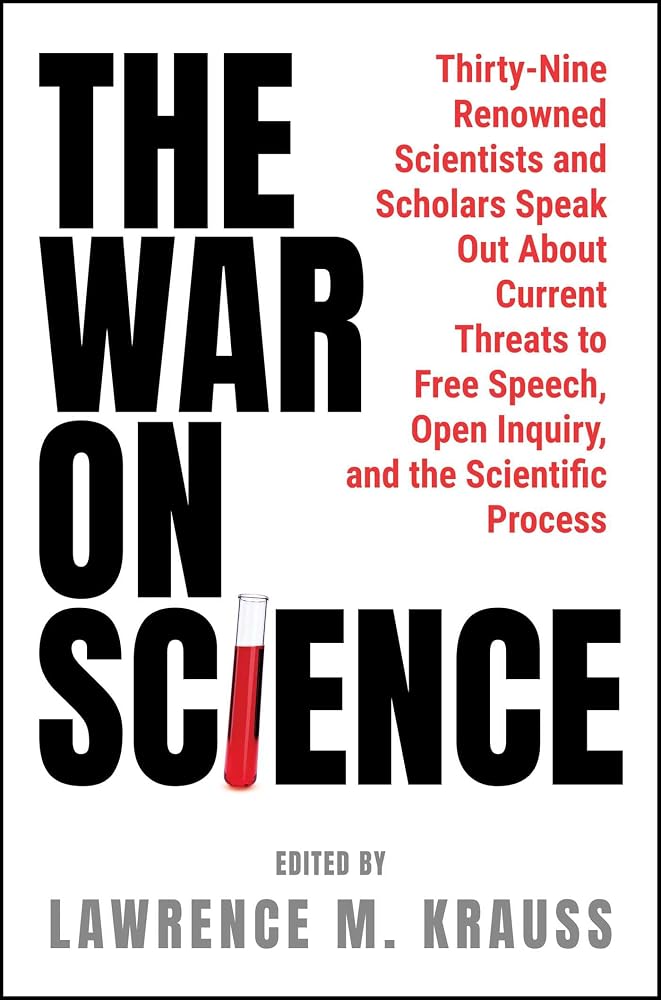
The War on Science: Thirty-Nine Renowned Scientists and Scholars Speak Out About Current Threats to Free Speech, Open Inquiry, and the Scientific Process | Lawrence M. Krauss, Dawkins, Peterson, Pinker, Ferguson, Saad
The War on Science: Thirty-Nine Renowned Scientists and Scholars Speak Out About Current Threats to Free Speech, Open Inquiry, and the Scientific Process | Lawrence M. Krauss, Dawkins, Peterson, Pinker, Ferguson, Saad
Couldn't load pickup availability
Share
Named Best Book of the Year in the UK by The Future Cities Project
An unparalleled group of prominent scholars from wide-ranging disciplines detail ongoing efforts to impose ideological restrictions on science and scholarship throughout western society.
From assaults on merit-based hiring to the policing of language and replacing well-established, disciplinary scholarship by ideological mantras, current science and scholarship is under threat throughout western institutions. As this group of prominent scholars ranging across many different disciplines and political leanings detail, the very future of free inquiry and scientific progress is at risk. Many who have spoken up against this threat have lost their positions, and a climate of fear has arisen that strikes at the heart of modern education and research. Banding together to finally speak out, this brave and unprecedented group of scholars issues a clarion call for change.
Topics include: Free speech, victimhood, ideology, corruption of academic disciplines, cancel culture, DEI, gender, and race, and what we can do.
“Higher education isn’t what it used to be. Cancel Culture and DEI have caused many to keep their mouths shut. Not so the authors of this book. This collection of essays tells of threats to open inquiry, free speech, and the scientific process itself. A much-needed book.”—Sabine Hossenfelder, Physicist and Author of Existential Physics: A Scientist’s Guide to Life’s Biggest Questions
With Contributions by:
Dorian Abbot, John Armstrong, Peter Boghossian, Maarten Boudry, Alex Byrne, Nicholas Christakis, Roger Cohen, Jerry Coyne, Richard Dawkins, Niall Ferguson, Janice Fiamengo, Solveig Gold, Moti Gorin, Karleen Gribble, Carole Hooven, Geoff Horsman, Joshua Katz, Sergiu Klainerman, Lawrence M. Krauss, Anna Krylov, Luana Maroja, Christian Ott, Bruce Pardy, Jordan Peterson, Steven Pinker, Richard Redding, Arthur Rousseau, Gad Saad, Sally Satel, Lauren Schwartz, Alan Sokal, Allesandro Strumia, Judith Suissa, Alice Sullivan, Jay Tanzman, Abigail Thompson, Amy Wax, Elizabeth Weiss, Frances Widdowson
.
Editorial Reviews
"Higher education isn’t what it used to be. Cancel Culture and DEI have caused many to keep their mouths shut. Not so the authors of this book. This collection of essays tells of threats to open inquiry, free speech, and the scientific process itself. A much-needed book." -- Sabine Hossenfelder, Physicist and Author of Existential Physics: A Scientist’s Guide to Life’s Biggest Questions
"Provocative, impassioned, and often personal, these essays by a starry cast of scholars offer vivid views of the most disturbing trend in academia today: the distortion of science by activists who put their idiosyncratic notions of social justice ahead of truth. Biology, medicine, and even math—not just the humanities and social sciences—are falling prey to DEI, decolonization, and de-sexed language. Not only does The War on Science elucidate the problem, it also models the solution: recommitment to scientific objectivity, scholarly integrity, and—above all—humility in the search for knowledge." -- Jonathan Rauch, Author of The Constitution of Knowledge
"The encroachment of ideology and groupthink on the production of knowledge may sound abstract, but it has a profound effect on every single aspect of life in the world today. The War on Science is an absolutely crucial response to this dangerous trend." -- Greg Lukianoff, President of the Foundation for Individual Rights and Expression, Author of Unlearning Liberty and Co-Author of The Coddling of the American Mind and The Canceling of the Am
"There may be no more perverse irony of history: The civilization that created the scientific method and that shared its fruits with all of humanity is now hell bent on destroying its creation. The destruction is coming from within science itself—perpetrated by ideologues, and abetted by administrators and scientists too cowardly to defend this greatest of intellectual accomplishments. With the publication of The War on Science, no university bureaucrat will be able to dismiss the anti-science crusade as just a ‘right-wing’ chimera. The War on Science marshals evidence from every corner of the scientific world to document the corruption of truth-seeking in favor of political fads. Its illustrious authors have defied censorship and vilification. If the authors’ peers gain the courage from this book to join the rebellion against enforced lies, there will yet be hope to salvage the scientific enterprise in the place of its birth." -- Heather Mac Donald, Thomas W. Smith Fellow at the Manhattan Institute, Author of When Race Trumps Merit
"This book is a clarion call. Woke imperialism, the new oppressor, steamrolls over religion, culture, customs, language, and reason, constructing a Tower of Babel where science isn’t just sidelined—it’s sent to DIE. We’re at DEFCON 1, alarms blaring as ideological spaghetti soldiers emerge from our universities, infiltrating all industries from aviation to medical and dismantling excellence with copypasta in the name of equity. The stakes are high: our future is on the line." -- Cyan Banister, Co-Founder and General Partner of Long Journey Ventures, Tech Investor (Uber, SpaceX, Anduril)
About the Author
I was born in New York City and shortly afterward moved to Toronto, spending my childhood in Canada. I received undergraduate degrees in mathematics and physics from Carleton University in Ottawa, Canada, and my Ph.D. from the Massachusetts Institute of Technology in 1982.
After a three-year stint in the Harvard Society of Fellows, I was a professor at Yale University for eight years and then, when I was 38, moved to become Ambrose Swasey Professor of Physics, professor of astronomy, and Chairman of the Physics Department at Case Western Reserve University. Since then, I have held endowed positions at a variety of universities around the world in departments ranging from physics and astronomy to earth and space exploration. I retired from academia in 2019 at age 65 when I became President of The Origins Project Foundation (www.originsprojectfoundation.org), an independent nonprofit foundation furthering the public understanding of science and enhancing connections between science and culture. In the same year, I became host of The Origins Podcast with Lawrence M. Krauss (www.theoriginspodcast.com), where I have extended video dialogues with the most interesting people in the world.
My research focuses on the beginning and end of the Universe. Among my contributions to the field of cosmology, I helped lead the search for dark matter and proposed the existence of dark energy in 1995, three years before its observational discovery, which received the Nobel Prize in 2011.
I write regularly for national media, including The New York Times, The New Yorker, the Wall St. Journal, The Globe and Mail, The National Post, Quillette, Prospect, and other magazines, as well as doing extensive work on radio and television and most recently in feature films.
I am strongly committed to public understanding of science and have helped lead the national effort to preserve sound science teaching, including the teaching of evolution, for which I was awarded the National Science Board’s Award for the Public Understanding of Science. I also served on Barack Obama’s 2008 Presidential campaign science policy committee. I was honored to be Chair of the Board of Sponsors of the Bulletin of the Atomic Scientists from 2006-2018, and from 2010-2019 was on the Board of Directors of the Federation of American Scientists.
I became a scientist in part because I read books by other scientists, such as Albert Einstein, George Gamow, Sir James Jeans, etc., when I was a child, and was inspired by meeting various scientist-heroes including Richard Feynman, and my popular writing returns the favor. One of my greatest joys is when a young person comes up to me and tells me that one of my books motivated them to become a scientist.
I believe science is not only a vital part of our culture but is fun, and I try and convey that in my books and lectures. I am honored that Scientific American referred to me as a rare scientific public intellectual, and that all three major US Physics Societies: the American Physical Society, the American Association of Physics Teachers, and the American Institute of Physics, have seen fit to honor me with their highest awards for research and writing.
I have now written 12 popular books on various aspects of science and culture, including the two New York Times Bestsellers, The Physics of Star Trek and A Universe from Nothing. These two books sold over 500,000 copies in English alone and the latter was translated into 25 languages.
My last book, The Physics of Climate Change, was published in March 2021. I wrote it during the pandemic, when I was able to take time to fully immerse myself in updating my knowledge of climate science and trying to translate it into popular language. This book cuts through the confusion by succinctly presenting the underlying science of climate change. It presents the underlying science behind climate change, free of political bias or jargon, so that all readers can understand one of the most important issues of our time, and allows laypeople to assess which climate predictions are firmest and which are more speculative. A departure from much of the focus of my previous books, it addresses a timely issue that should impact the basis of ongoing public policy.
My newest book, The Edge of Knowledge: Unsolved Mysteries of the Cosmos (in the UK it is entitled The Known Unknowns: The Unsolved Mysteries of the Cosmos), is a roller coaster ride taking us to the limits of what we know, and more importantly, what we know we don’t know about the Universe. Divided into 5 sections: Time, Space, Matter, Life, and Consciousness, it takes on the greatest unsolved problems in science. It is a celebration of how far we have come in understanding the universe, while providing an invitation to the next generation of young people to take up the challenge. The Universe continues to surprise us, but it will only do that if we keep asking questions and keep exploring it. The rewards are ultimately a better understanding of our own place in the cosmos, including where we came from and where we are heading.
When not writing or doing research or relaxing at home with my family, I love to mountain bike, fly fish, and scuba dive.
You can find more about my research, my activities, and my opinions on my substack site Critical Mass at LawrenceKrauss.substack.com or web page lawrencemkrauss.com or on my Twitter feed @Lkrauss1 or at https://wakelet.com/@LawrenceKrauss.
Product details
-
Publication
Post Hill Press
-
Author
Lawrence M. Krauss, Dawkins, Peterson, Pinker, Ferguson, Saad
-
Language
English
Lexile:
-
Pages
480
-
ISBN-13
9798888457566