
-
 Editor's Pick

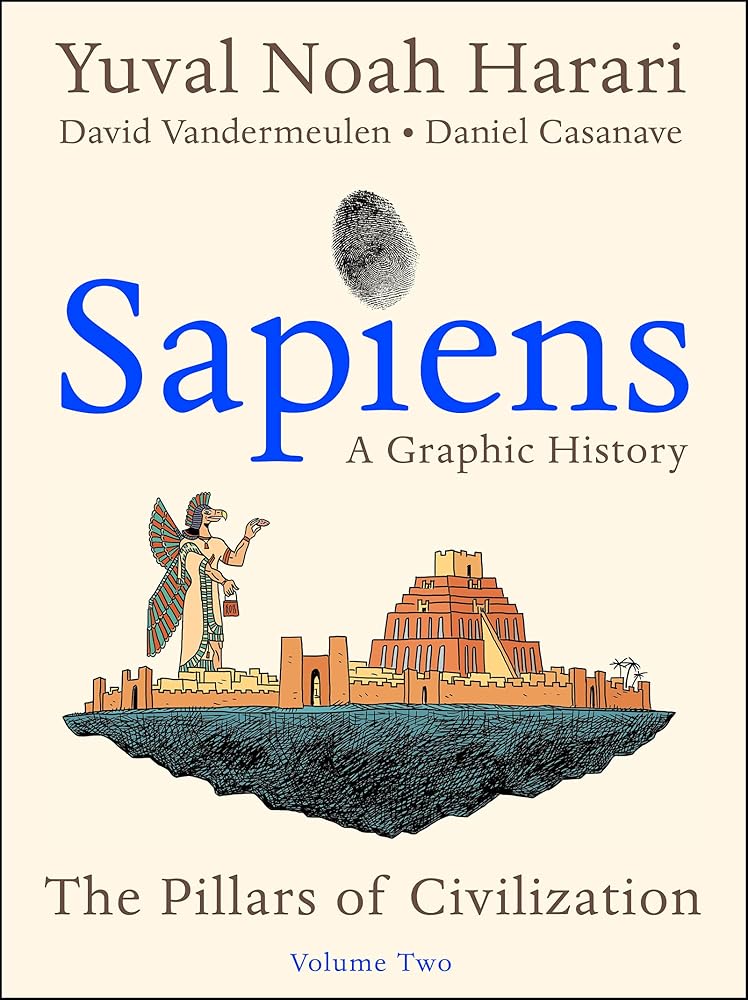
Sapiens: A Graphic History, Volume 2: The Pillars of Civilization (Sapiens: A Graphic History, 2) | Yuval Noah Harari
Sapiens: A Graphic History, Volume 2: The Pillars of Civilization (Sapiens: A Graphic History, 2) | Yuval Noah Harari
SKU: 9780063212237
Couldn't load pickup availability
Share
The Agricultural Revolution and the Rise of Human Civilization
NATIONAL BESTSELLER
This second volume of Sapiens: A Graphic History, the full-color graphic adaptation of Yuval Noah Harari’s #1 New York Times bestseller, focuses on the Agricultural Revolution—when humans fell into a trap we’ve yet to escape: working harder and harder with diminishing returns.
What if humanity’s major woes—war, plague, famine and inequality—originated 12,000 years ago, when Homo sapiens converted from nomads to settlers, in pursuit of the fantasy of productivity and efficiency? What if by seeking to control plants and animals, humans ended up being controlled by kings, priests, and Kafkaesque bureaucracy? Volume 2 of Sapiens: A Graphic History–The Pillars of Civilization explores a crucial chapter in human development: the Agricultural Revolution. This is the story of how wheat took over the world; how an unlikely marriage between a god and a bureaucrat created the first empires; and how war, plague, famine, and inequality became an intractable feature of the human condition.
But it’s not all doom and gloom with this book’s cast of entertaining characters and colorful humorous scenes. Yuval, Zoe, Prof. Saraswati, Cindy and Bill (now farmers), Detective Lopez, and Dr. Fiction, all introduced in Volume 1, once again travel the length and breadth of human history, this time investigating the impact the Agricultural Revolution has had on our species. The cunning Mephisto shows them how to ensnare humans, King Hammurabi lays down the law, and Confucius explains harmonious society. The origins of modern farming are introduced through Elizabethan tragedy; the changing fortunes of domesticated plants and animals are tracked in the columns of the Daily Business News; the story of urbanization is portrayed as a travel brochure, offering discount journeys to ancient Babylon and China; and the history of inequality unfolds in a superhero detective story; with guest appearances by historical and cultural personalities throughout such as Thomas Jefferson, Scarlett O'Hara, Margaret Thatcher, and John Lennon.
Sapiens: A Graphic History, Volume 2 is a radical, witty and colorful retelling of the story of humankind for adults and young adults, and can be read on its own or in sequence with Volume I.
.
Editorial Reviews
Starry Ferry Books' Recommendation
When Progress Came at a Price: Rethinking the Birth of Civilization
Did humanity domesticate wheat, or did wheat domesticate humanity? Did the birth of civilization truly make our lives better?
In Sapiens: A Graphic History, Volume 2: The Pillars of Civilization, Yuval Noah Harari, David Vandermeulen, and Daniel Casanave challenge conventional assumptions about human progress. Taking readers back approximately 12,000 years, they explore how the transition from hunting and gathering to agricultural settlements fundamentally transformed human societies, bringing both remarkable achievements and new social challenges.
Through imaginative storytelling, historical satire, and vibrant illustrations, the book examines the emergence of ancient civilizations, organized religion, written laws, social hierarchies, and political institutions. Rather than presenting history as a straightforward march toward progress, Harari invites readers to consider the complicated relationship between productivity, prosperity, freedom, and human happiness.
In its starred review, Kirkus Reviews describes the book as an entertaining educational experience, praising its ability to explain how shared narratives and cultural beliefs have influenced human behavior and social institutions.
Readers interested in exploring Harari's broader historical arguments can turn to the original work, 人類大歷史:從野獸到扮演上帝 (Sapiens: A Brief History of Humankind), available in Traditional Chinese. Meanwhile, Sapiens: A Graphic History, Volume 4 extends this historical journey into the Scientific and Industrial Revolutions, examining how technological advancements have reshaped civilization.
Engaging, intellectually stimulating, and visually inventive, this graphic history is an excellent choice for teenagers and adults interested in anthropology, ancient civilizations, and the origins of modern society. It is particularly valuable as a starting point for historical discussions and critical thinking, encouraging readers to examine Harari's interpretations alongside other historical and archaeological perspectives.
Ultimately, the book leaves us with an enduring question: does becoming more productive, powerful, and technologically advanced necessarily mean becoming happier?
About the Author
Product details
-
Publication
Harper Perennial
-
Author
-
Pages / Size
256
-
ISBN-13
9780063212237